

What Is Open Source Software Security and Why It Matters for DevOps, Platform Engineers and IT Operations
Open source software security is essential for modern development. It provides cost-effective and innovative solutions, but it also introduces security risks. Organizations must actively manage open source security vulnerabilities by monitoring dependencies, detecting threats, and implementing proactive measures to reduce potential risks across their software supply chain.
Key points:
- Open source security manages vulnerabilities and integrity risks across third-party components powering modern software delivery pipelines.
- Organizations must track CVEs, SBOMs, licenses, and provenance without centralized vendor patching.
- Continuous monitoring and automated remediation reduce exposure from dependency drift, transitive risks, and delayed patching.
- Embedding security into CI/CD and runtime environments enables proactive, continuous OSS defense.
Introduction to Open Source Software Security
Modern applications are built on the shoulders of open source software (OSS). From container runtimes and libraries to CI/CD pipelines, open source powers nearly every stage of development and deployment. But with great flexibility comes risk. Open source security is the practice of managing vulnerabilities and ensuring the integrity of third-party components that make up your software.
For DevOps, platform engineers, and IT operations teams, OSS security isn’t optional—it’s foundational. You’re responsible for the platforms and pipelines that deploy and operate critical services, and those systems depend on hundreds (if not thousands) of open source packages.
What is Open Source Security?
Open source security involves identifying, assessing, and mitigating vulnerabilities in open source components used within applications and infrastructure. It’s about protecting your codebase and runtime environments from risks introduced through external dependencies.
Unlike proprietary software, open source doesn’t have a centralized vendor issuing patches or guarantees. This means engineers, security and IT operations teams must take responsibility for tracking vulnerabilities—using data sources like the National Vulnerability Database (NVD), OpenSSF Scorecard, and OSV.dev, and implementing fixes through their build and deployment processes.
At its core, open source security includes:
- Vulnerability Management: Detecting and prioritizing CVEs (Common Vulnerabilities and Exposures) in third-party libraries and containers.
- SBOM Management: Maintaining a Software Bill of Materials to know exactly which components and versions are running in production.
- License Compliance: Ensuring OSS components comply with organizational and legal policies.
- Provenance and Integrity: Verifying that packages come from trusted sources and haven’t been tampered with.
Open Source Software Risks
In DevOps, speed and automation are everything. But every dependency added to your pipeline increases your attack surface. If you don’t know what’s in your software, you can’t secure it—or patch it—when new CVEs emerge.
Key risks include:
- Dependency Drift: A package version may introduce vulnerabilities after deployment.
- Transitive Dependencies: Your dependencies’ dependencies often go unseen but can introduce critical flaws.
- Pipeline Exposure: Build systems and container registries can be targeted to inject malicious code.
- Delayed Patching: Manual remediation workflows lead to long mean-time-to-remediate (MTTR).
In 2025, the average time between a vulnerability’s public disclosure and active exploitation is under 10 days, while most organizations take over 100 days to patch. That’s an unacceptable gap in a CI/CD world.
Platform Engineering and Continuous Security
Platform engineers are building internal developer platforms that must be secure by design. Integrating open source software security into the platform ensures that every service, pipeline, and runtime image is continuously monitored for vulnerabilities.
This means embedding security into your workflows:
- Integrate SBOM generation into your CI/CD pipelines.
- Use automated vulnerability detection tools to track new CVEs post-deployment.
- Employ digital twins or observability platforms to map vulnerabilities to live running workloads without relying on intrusive agents.
- Automate remediation workflows to reduce developer toil.
Open source security isn’t about slowing down releases, it’s about ensuring that your automation delivers software you can trust.
The Future of Open Source Security
With regulatory mandates (like the U.S. Executive Order on Improving the Nation’s Cybersecurity) and growing adoption of SBOMs, open source security is evolving into a continuous process. The focus is shifting from pre-deployment scanning to post-deployment visibility, giving DevOps and platform teams real-time insight into where vulnerabilities exist and how to fix them fast.
Forward-thinking organizations are working to integrate open source security directly into their CI/CD pipelines, runtime environments, and IT operations workflows—ensuring vulnerability detection and remediation are continuous rather than reactive.
Tools like DeployHub and Ortelius are pioneering this approach by turning static SBOMs into live, actionable intelligence—linking vulnerabilities directly to deployed components for faster remediation.
Open source security isn’t just another checkbox, it’s the backbone of modern software delivery. For DevOps and platform engineers, securing open source means securing your entire delivery pipeline. With automation, visibility, and continuous monitoring, you can transform your platform into a secure foundation for innovation.
The Cost of Open Source Vulnerabilities
Open source security isn’t just another checkbox—it’s the backbone of modern software delivery. For DevOps and platform engineers, securing open source means securing your entire delivery pipeline. With automation, visibility, and continuous monitoring, you can transform your platform into a secure foundation for innovation.
Code-level vulnerabilities are a looming threat in the complex landscape of decoupled cloud-native computing. According to IBM’s Cost of Data Breach report, a slow response to vulnerabilities can cost enterprises an average of $5.5 million annually. Globally, the figure balloons to a staggering $9.5 trillion, an indicator of how widespread and severe the threat has become.
Continuous vulnerability management is required to contain the cost of open source risks.
5 Best Practices for Integrating Open Source Security
1. Automate SBOM Creation and Aggregation
Embed SBOM generation into every stage of your CI/CD pipeline to ensure continuous visibility into all open source dependencies. Automatically collect and aggregate SBOMs from builds, containers, and third-party components into a centralized system. This creates a reliable inventory of what’s in your software—across development, staging, and production—so you can quickly assess exposure when new vulnerabilities emerge.
2. Monitor Continuously, Not Periodically
Static scans during development are not enough for effective open source software security. Implement continuous, post-deployment monitoring that maps vulnerabilities to live workloads and running services. When new CVEs are disclosed, your security tooling should automatically determine whether affected components are actively deployed—so teams can focus on real risk, not theoretical exposure.
3. Shift Remediation Left and Right
Adopt a dual approach to vulnerability management. Shift left by detecting and fixing issues early in the CI pipeline before code reaches production. Shift right by continuously monitoring production environments for newly disclosed CVEs and runtime threats. This balanced strategy reduces risk throughout the entire software lifecycle, not just at build time.
4. Use a Centralized Evidence Store
Aggregate SBOMs, vulnerability data, and deployment metadata into a single source of truth—a digital twin of your software supply chain. A centralized evidence store enables faster incident response, simplifies compliance reporting, and provides DevOps and security teams with shared, real-time visibility into software risk.
5. Reduce Developer Toil Through Automation
Security processes should accelerate development, not slow it down. Integrate automated remediation workflows that prioritize vulnerabilities by exploitability and runtime impact. Where possible, generate pull requests, suggest safe dependency upgrades, or automate patching to reduce manual effort. This keeps developers focused on shipping features while maintaining a strong security posture.
How DeployHub Helps with Open Source Software Security
DeployHub moves open source security beyond static scanning by delivering continuous, post-deployment vulnerability detection. It maps SBOM data to what’s actually running across your environments, giving DevOps and platform teams real-time visibility into deployed components and their risk exposure.
Rather than relying on intrusive agents or endpoint scanners, the platform creates a digital twin of the software supply chain to pinpoint exactly where vulnerable components are running. When a new CVE is published, affected applications and endpoints are immediately identified, enabling fast, targeted remediation with minimal developer effort.
By automating SBOM aggregation and vulnerability tracking, DeployHub transforms open source security from a reactive process into an intelligent, continuous defense model built for modern DevOps and platform engineering.
Frequently Asked Questions
Open-source software security is the practice of identifying, assessing, and mitigating vulnerabilities in open-source components used in applications and infrastructure. It’s important because most modern applications rely heavily on open-source packages, and unpatched vulnerabilities can expose critical systems to attacks.
Unlike proprietary software, open-source projects often lack a centralized vendor responsible for patches. This places the onus on DevOps and platform teams to monitor, detect, and remediate vulnerabilities proactively.
Key risks include dependency drift (vulnerabilities appearing in previously safe packages), transitive dependencies (hidden risks from dependent libraries), pipeline exposure (injection of malicious code), and delayed patching leading to high mean-time-to-remediate (MTTR).
SBOMs (Software Bills of Materials) provide an inventory of all components and dependencies. They allow teams to quickly identify which components are affected by new CVEs, assess risks, and prioritize remediation actions in both pre- and post-deployment stages.
Because new vulnerabilities are discovered daily, continuous monitoring ensures that organizations can detect and remediate threats in real time, rather than relying on periodic scans that may leave gaps in security coverage.
Platform engineers build secure internal developer platforms and CI/CD pipelines, integrating SBOM generation, automated vulnerability detection, and remediation workflows to protect the software supply chain without slowing down development.
Transitive dependencies occur when a component depends on other components. These indirect dependencies may contain unpatched vulnerabilities that are not immediately visible, increasing the potential attack surface.
Delays between vulnerability disclosure and remediation can be costly. With attackers exploiting high-severity CVEs in under 10 days, slow patching can lead to breaches, operational disruption, and millions in damages.
Embedding security practices such as SBOM generation, automated CVE detection, and compliance checks directly into CI/CD pipelines ensures vulnerabilities are caught early, reduces developer toil, and prevents risky components from reaching production.
Open-source security is evolving toward continuous, post-deployment monitoring. Real-time visibility into running workloads, automated remediation, and supply chain mapping will become standard practices, transforming security from a reactive to a proactive discipline.
Manage Open Source Software Vulnerabilities with DeployHub
DeployHub manages open source software security by tracking your inventory and security profile across the entire software supply chain, including production environments.
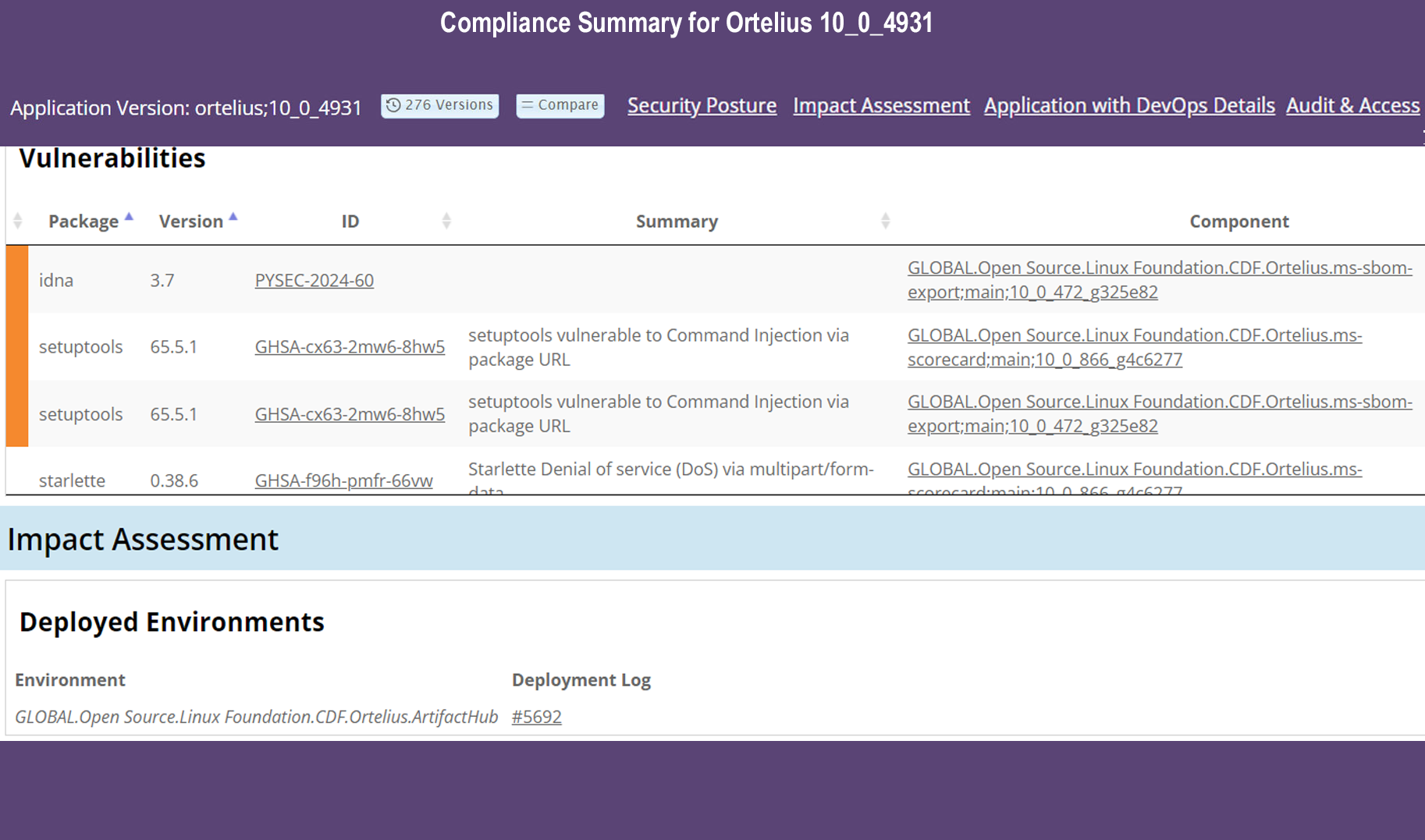
The DeployHub Platform
- Post-Deployment Vulnerability Detection Detects new CVEs in real time after deployment by mapping them directly to live running services and applications—no agent required.
- Automated SBOM Aggregation Continuously collects and consolidates SBOMs across builds, containers, and microservices into a single, searchable evidence store.
- Digital Twin of the Software Supply Chain Creates a “living” digital twin of all deployed components, enabling instant visibility into which endpoints and workloads are affected by new vulnerabilities.
- Dependency and CVE Impact Mapping Automatically correlates vulnerabilities to their impacted applications and versions, helping teams prioritize remediation based on business risk.
