
Key Concept
A digital twin for software security is a continuously updated virtual model of deployed software, including its components, dependencies, versions, applications, and environments. It connects build-time evidence such as SBOMs with deployment data and vulnerability intelligence to show what is actually running in production.
For cybersecurity and DevSecOps teams, a software security digital twin provides the production context needed to identify newly disclosed vulnerabilities, understand where affected components are deployed, and respond to risk after software has been released.
Deployment Digital Twins for Detecting Open-Source Vulnerabilities
A digital twin for software security is a living model of the software deployed across an organization. It maintains the relationships between applications, open-source packages, versions, dependencies, environments, and endpoints as software moves from development into production.
Unlike a static inventory, SBOM, or point-in-time scan, a software security digital twin changes as deployments change. When a new CVE is disclosed, teams can use the twin to determine whether the affected component is actually deployed, where it is running, and which applications or environments are exposed.
At DeployHub, this concept powers our post-deployment vulnerability detection and auto-remediation engine. We use twins to connect vulnerabilities to specific running components, helping teams fix the right problem faster, with no endpoint agents or rescans required.
Software security changes after deployment. Applications are updated, dependencies shift, new versions are released, and vulnerabilities are disclosed against packages that may have been considered safe when the software was built.
A software security digital twin preserves the connection between what was built and what is currently deployed. That allows security teams to move beyond static vulnerability lists and understand which newly discovered risks actually affect live systems.
The result is continuous production context: what software is running, where it is running, what it depends on, and how new vulnerability intelligence changes its security posture.
Digital twins originated as virtual representations of physical systems used to understand changing conditions without interacting directly with the live system. The same principle can be applied to software. Instead of modeling a jet engine or spacecraft, a software digital twin models applications, components, dependencies, deployment locations, and security posture.
A DevSecOps digital twin can turn production visibility into automated security action. Because the twin maintains current information about deployed components and their relationships, vulnerability intelligence can be continuously evaluated against the software actually running.
Over time, this creates the foundation for self-defending software: systems that can detect new exposure, identify affected applications, initiate remediation workflows, and verify that risk has been reduced.
Unlike static dashboards or periodic scans, a digital twin evolves in real time with the system, providing a continuously updated mirror of running applications and their relationships.
Digital twins provide real-time visibility into running systems, enabling proactive detection of vulnerabilities, misconfigurations, and other risks that emerge after deployment.
Yes. By mapping live components and dependencies against known CVEs, digital twins allow teams to pinpoint exactly which parts of their environment are exposed.
Because they maintain an accurate, up-to-date model of the system, digital twins can be used to trigger automated patching, configuration fixes, or other mitigation strategies in real time.
Absolutely. Digital twins track changes across clusters, containers, and serverless functions, ensuring visibility and security even in short-lived or highly dynamic workloads.
Digital twins can ingest data from CI/CD pipelines, SBOMs, telemetry, and operational logs to continuously synchronize the live environment with build-time and runtime information.
Yes. By analyzing real-time data and historical patterns, digital twins can anticipate risk events, such as exploitable vulnerabilities or misconfigurations, before they impact production.
They provide a detailed, continuously updated record of all deployed components, configurations, and vulnerability status, supporting traceability and reporting for regulatory compliance.
Deployment digital twins could evolve into self-defending systems that automatically detect, prioritize, and mitigate threats in real time, forming the foundation of an intelligent digital immune system for software.
Choosing a digital twin for software security platform should focus on whether it can maintain a continuously updated model of what is actually running in production. Look for a solution that connects SBOMs, applications, component versions, dependencies, deployment events, environments, and endpoints into a single security model that evolves as your software changes. The platform should continuously correlate newly disclosed vulnerabilities against that model so teams can immediately determine whether an affected package is deployed, where it is running, and which applications or environments are exposed. Unlike static inventories or periodic scans, a strong software security digital twin provides persistent production context, giving security and DevSecOps teams the visibility needed to prioritize real exposure, accelerate remediation, and maintain an auditable history of software and vulnerability risk.
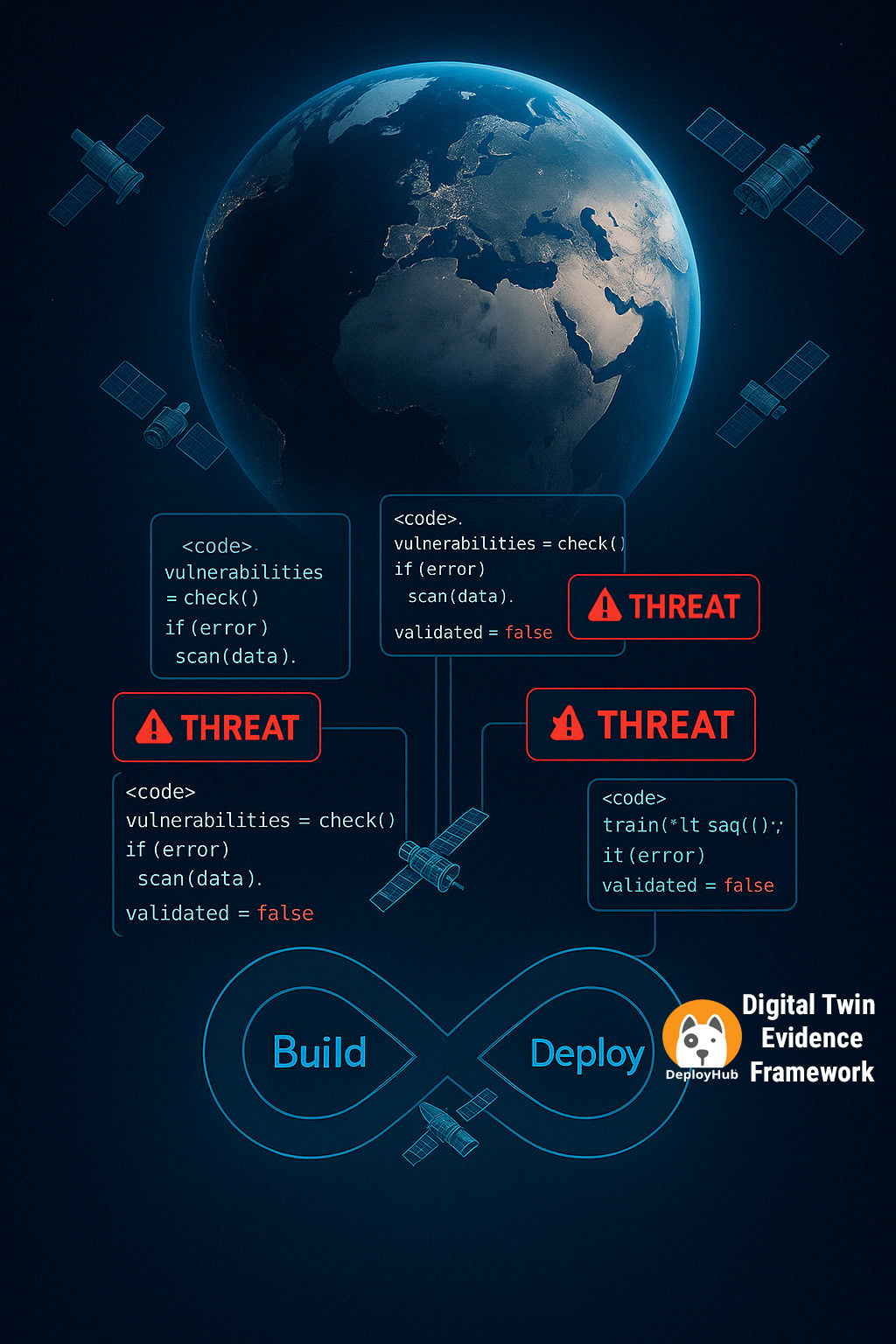

DeployHub applies the digital twin for software security concept to post-deployment vulnerability defense. It connects SBOM data, deployment events, applications, environments, endpoints, and vulnerability intelligence into a continuously updated security model.
When a new vulnerability is disclosed, DeployHub can evaluate the digital twin to determine whether the affected package is present in deployed software and identify where that software is running. Because the model exists outside the live endpoint, this visibility does not depend on installing traditional endpoint agents or repeatedly rescanning production systems.
The DeployHub Pro Platform


meet ortelius
DeployHub is built on Ortelius, the open-source foundation for post-deployment vulnerability intelligence. Ortelius connects SBOMs, deployment data, applications, environments, and endpoints so teams of all sizes and budget constraints can determine whether newly disclosed vulnerabilities are actually affecting live systems.
Ortelius is an open-source project incubating at the Continuous Delivery Foundation.