

What is Vulnerability Remediation?
Vulnerability Remediation is the process of fixing or mitigating security weaknesses in systems, applications, or networks to prevent exploitation. It addresses issues identified through scans, audits, or threat reports and is a key function within a broader vulnerability management lifecycle that includes detection, prioritization, remediation, and continuous monitoring.
Remediation can include patching open-source dependency files, updating container images, changing configurations, or applying compensating controls to reduce exposure.
Why Post-Deployment Open-Source Vulnerability Remediation Is Critical
The future of DevSecOps lies in systems that can defend themselves. By giving software a digital twin, teams gain the ability to see, understand, and respond to threats automatically, turning visibility into action.
Digital twins are more than a data model; they are the foundation of a digital immune system for modern software — where speed, security, and intelligence converge.
- New vulnerabilities are disclosed daily.
- Developers lose visibility into where those open-source packages are running.
- Attackers weaponize high-severity CVEs in under 10 days, while typical remediation still takes 100+ days.
Static scanners and SCA tools can’t protect running systems or identify which live endpoints are impacted when a new CVE hits.
That’s why post-deployment vulnerability defense is essential. It extends protection into runtime environments, where open-source components actually execute, ensuring that newly disclosed vulnerabilities are detected, mapped, and remediated before they can be exploited.
The first and most critical step is knowing where the impacted OSS packages are deployed. Without a live map of your software ecosystem, it’s impossible to accurately assess risk, prioritize fixes, or validate closure.
DeployHub solves this through its digital twin, which continuously tracks open-source components across cloud, edge, and space systems. When a new CVE is published, DeployHub instantly identifies the affected versions, cutting mean time to remediation (MTTR) from months to days, and pinpointing the high-risk and critical CVEs developers should focus on.
The Vulnerability Remediation Lifecycle
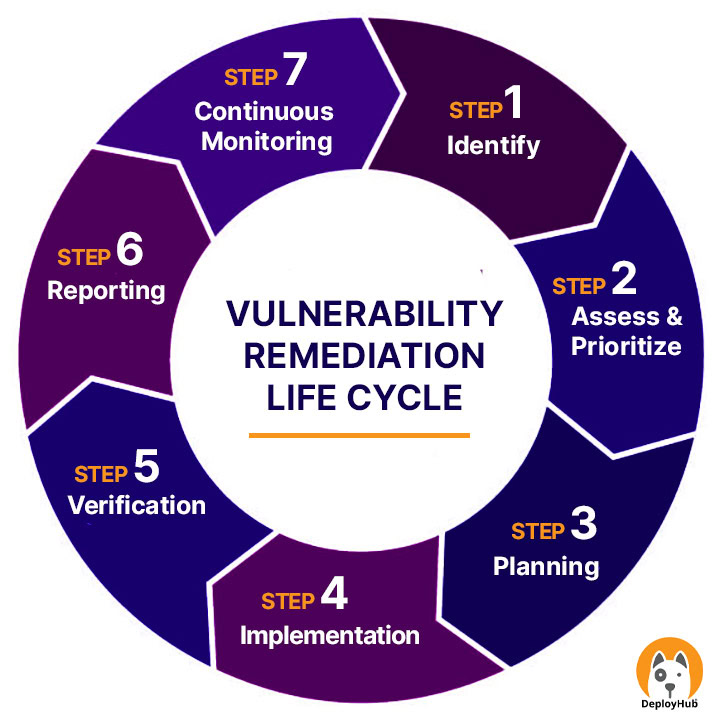
The process remains cyclical: identify, assess, plan, remediate, verify, document, and monitor. For open-source CVEs, each stage benefits from continuous post-deployment visibility.
1. Identification
Detect open-source vulnerabilities using CVE feeds, OSV.dev, and DeployHub’s SBOM correlation engine. Output: A complete list of affected OSS components and the endpoints where they are running.
2. Assessment & Prioritization
Evaluate risk by severity, exploitability, and runtime exposure. Output: Prioritized remediation list focused on live, exploitable threats.
3. Remediation Planning
Define update paths, compatible package versions, and safe deployment sequences. Output: Coordinated patch plan aligned to CI/CD pipelines and runtime systems.
4. Remediation Implementation
Apply updates automatically across environments, verifying compatibility and rollback safety.
5. Verification & Testing
Validate that patched components are deployed and CVEs are closed by cross-checking live SBOMs against updated package versions.
6. Documentation & Reporting
Every step is logged, producing traceable evidence for compliance frameworks such as NIST 800-53, CMMC, and DoD RMF.
7. Continuous Monitoring
New OSS CVEs appear daily. DeployHub continuously monitors vulnerability feeds and automatically correlates new disclosures to its digital twin — identifying new threats to production systems in real time.
Vulnerability Remediation Best Practices for Open-Source CVE Defense
Here are DeployHub-enabled best practices for defending against CVEs, powered by the platform’s unique visibility and automation capabilities.
1. Integrate SBOM Generation into CI/CD Pipelines
Generate SBOMs automatically during the build process to catch vulnerable dependencies before they reach production. Early integration ensures security checks are part of standard workflows, reducing post-deployment surprises.
2. Continuously Monitor Post-Deployment OSS Components
Security doesn’t end at build time. DeployHub tracks deployed open-source packages across environments and alerts the moment a new CVE applies. Frequent, automated scans ensure vulnerabilities are identified as soon as they emerge.
3. Map Every Vulnerable Dependency to Its Live Endpoint
The digital twin provides runtime traceability, showing which services, clusters, or devices are using each vulnerable OSS component. This contextual mapping enables precise remediation.
4. Treat SBOMs as Living Intelligence
DeployHub transforms SBOMs from static artifacts into dynamic security intelligence. When a CVE is disclosed, DeployHub automatically queries the SBOM, matches it to live assets, for fast remediation.
5. Automate Detection-to-Remediation Workflows
Open-source CVEs emerge faster than humans can patch. DeployHub automates detection, risk prioritization, and alerting, reducing manual triage and accelerating response times. and prioritization, reducing manual triage.
6. Prioritize Based on True Exposure (Blast Radius)
Not all CVEs are equal. DeployHub determines the attack surface by linking each OSS CVE to its deployed context, ensuring the highest-impact vulnerabilities are fixed first.
7. Include Licensing and Compliance Checks
Vulnerability management isn’t only about security. Track licensing, provenance, and regulatory requirements alongside CVEs to ensure software components are safe, legal, and auditable.
8. Collaborate Across Teams
Share SBOM and CVE insights across DevOps, security, and platform engineering teams. Integrate alerts into ticketing systems and assign remediation ownership to streamline response and accountability.
9. Maintain Audit-Ready Evidence and Metrics
Keep a live repository of SBOM and CVE data to document remediation actions, generate audit reports, and measure key metrics like mean time to remediation (MTTR), number of CVEs mitigated, and reduction in exposed blast radius. Continuous monitoring enables iterative improvement and informed decision-making.
10. Integrate with Existing Security Tools
DeployHub’s insights can feed into SIEMs, vulnerability scanners, and other security workflows, ensuring your organization has a unified view of risk across all systems and environments.